The Power of Vite ⚡
Vite is a modern build tool that aims to provide a faster and leaner development experience and production build for modern web projects.
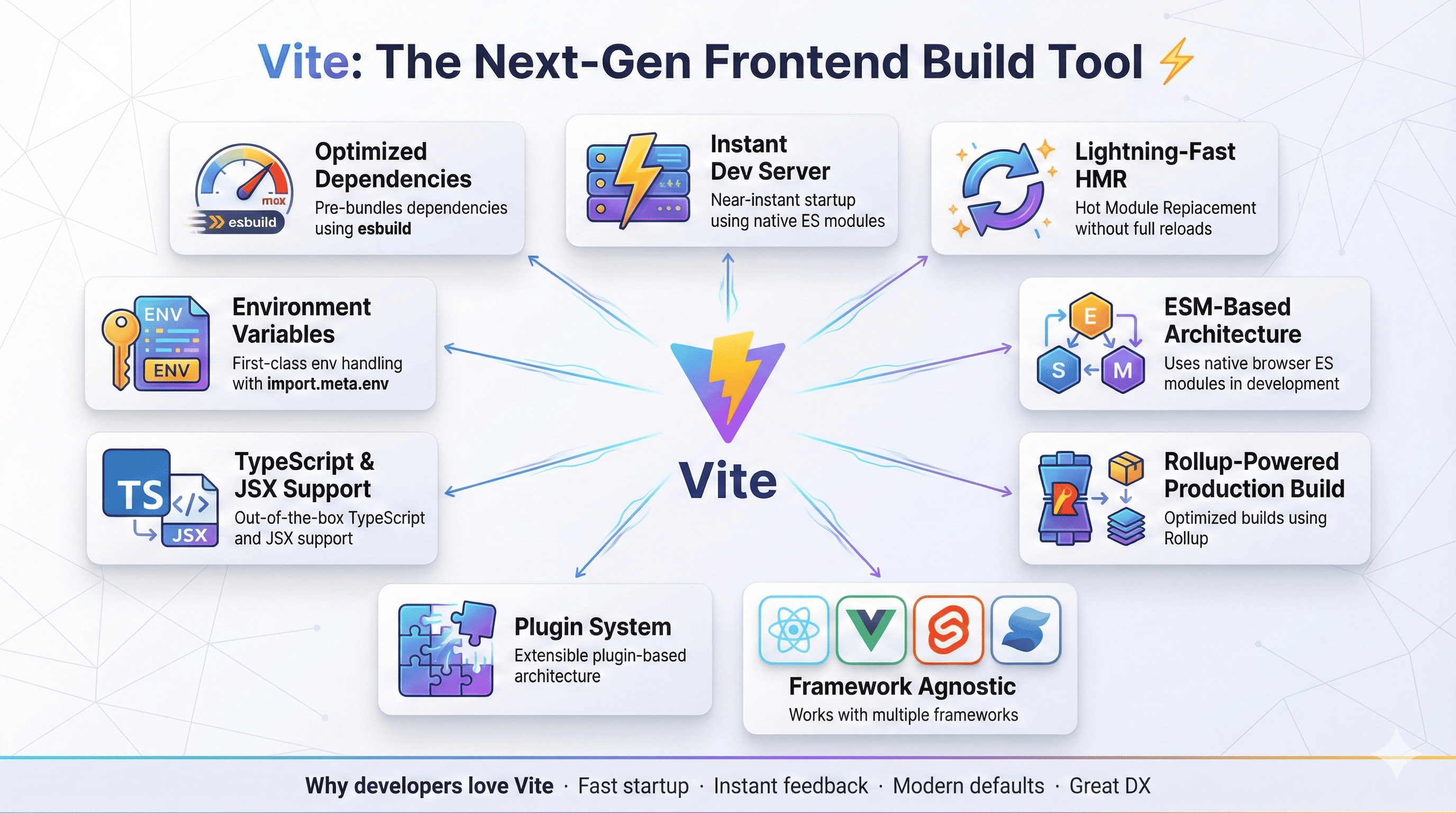
Why modern frontend development finally feels... fast?
If you’ve been building web apps for a few years, you probably remember this pain:
You run:
npm start
And then you wait.
And wait.
And maybe check Slack.
And maybe make coffee.
And then the dev server finally starts.
Now imagine this instead:
You run the same command and your app opens instantly.
No warm-up.
No bundling delay.
No “Compiling...” screen that lives forever.
That feeling is Vite. Vite word is derived from french word "vite" which means quickly.
But Vite is not just “a faster dev server”.
It represents a fundamental shift in how frontend tooling works.
Let’s break it down from scratch.
1. First principles: What problem does Vite solve?
Before understanding Vite, we need to understand what we were doing wrong before.
What happens when you build a frontend app?
When you write frontend code, you don’t ship this to the browser:
import React from "react";
import App from "./App";
Browsers historically did not understand:
importstatements (earlier)- JSX
- TypeScript
- CSS imports in JS (e.g.
import "./styles.css") - Module aliases (e.g.
@/*) - Tree-shaking logic
So tools like Webpack came in and said:
“Okay, I’ll take of everything - all your JS, CSS, images -
smash them together, process them, and give the browser one big bundle.”
This process is called bundling.
2. What is bundling?
Bundling means:
Taking many files and combining them into fewer files (often one).
Example:
App.jsx
Button.jsx
Header.jsx
utils.js
styles.css
Bundled into:
bundle.js
This made sense when browsers were dumb.
But bundling has a big downside.
3. The real problem with traditional bundlers
Bundlers like Webpack do too much work too early.
When you start a dev server, Webpack:
- reads every file
- parses dependency graphs (e.g.
importstatements) - transforms everything (e.g. JSX, TypeScript)
- bundles everything
- then starts the server
Even if you only open one page.
That’s why:
- cold starts are slow
- large apps feel painful
- adding one dependency increases startup time
This is not a “bad implementation”.
It’s a bad assumption.
The assumption was:
“We must bundle everything before the browser sees anything.”
Vite challenges this assumption.
4. The key idea behind Vite (this is the magic)
Vite asks a simple but powerful question:
“What if we don’t bundle during development at all?”
And that question changes everything.
5. Modern browsers changed the game
Modern browsers now support:
Native ES Modules
This means browsers can understand:
import { add } from "./math.js";
Without bundling.
So instead of shipping one giant bundle, the browser can:
- request files on demand
- load only what it needs
- cache aggressively
Vite builds directly on this capability.
6. But wait...What Vite actually is?
Vite is:
A frontend build tool that uses native ES modules during development
and bundles efficiently for production.
Two modes. Two strategies.
| Mode | Strategy |
|---|---|
| Development | No bundling |
| Production | Optimized bundling |
This split is the secret sauce.
7. How Vite works in development (step by step)
Let’s say you run:
npm run dev
Here’s what Vite does:
- Starts a lightweight dev server
- Serves your
index.htmldirectly - Browser requests JS files as needed
- Vite transforms files on demand
- No full app bundling
This means:
- Instant startup
- Near-zero memory pressure
- Faster feedback loops
If you don’t open a file, Vite doesn’t process it.
8. “But what about JSX, TypeScript, etc?”
Great question.
Vite uses esbuild (written in Go) under the hood.
What is esbuild?
esbuild is:
- insanely fast
- written in a compiled language (Go)
- designed for speed, not flexibility
It handles:
- JSX (JSX to JS)
- TypeScript (TS to JS)
- modern JS syntax (ESM, Top-level await, etc.)
- imports (ESM, CommonJS, etc.)
This is why Vite feels unreasonably fast.
9. Why Vite feels instant (the real reason)
Traditional tools:
- bundle first
- then serve
Vite:
- serve first
- transform only when requested
Think of it like this:
Old way
“Cook the entire menu before any customer arrives.”
Vite’s way
“Cook only what the customer orders - when they order it.”
That’s the mindset shift.
10. Hot Module Replacement (HMR) - done right
What is HMR?
HMR means:
Updating code in the browser without refreshing the page
But not all HMR is equal.
In older tools:
- changing one file could invalidate large chunks
- state was often lost
- updates were slow
Vite’s HMR is surgical
Because modules are not bundled, Vite knows exactly:
- which file changed
- which modules depend on it
So it updates:
- only what’s necessary
- instantly
- without reloading the page
You type -> browser updates.
No lag.
11. Vite and production builds (important)
Now here’s where people get confused:
“If Vite doesn’t bundle, how does production work?”
Answer: Vite absolutely bundles for production.
But it uses Rollup, not Webpack.
Why Rollup?
Rollup:
- produces smaller bundles
- has excellent tree-shaking
- generates clean output
- is predictable
Vite uses:
- esbuild for dev speed
- Rollup for production quality
Best of both worlds.
12. Tree-shaking
Tree-shaking means:
Removing unused code from your final bundle as simple as that.
Example:
import { add, subtract } from "./math";
If you only use add, tree-shaking removes subtract.
Result:
- smaller bundles
- faster load times
- happier users
Vite + Rollup do this extremely well.
13. Vite’s plugin system
Vite plugins are:
- Rollup plugins (mostly)
- plus some Vite-specific hooks
This means:
- huge existing ecosystem
- familiar mental model
- predictable behavior
Plugins can:
- transform code
- inject environment variables
- optimize assets
- add frameworks
14. Vite + frameworks (React, Vue, etc.)
Vite is framework-agnostic, but shines with:
- React
- Vue (created by Vue’s author Evan You)
- Svelte
- Solid
- Preact
Example (React):
npm create vite@latest
You get:
- minimal config
- instant dev server
- clean project structure
No webpack config jungle.
15. Environment variables (clear rules)
Vite environment variables:
- must start with
VITE_ - are statically injected
Example:
VITE_API_URL=https://api.example.com
Accessed via:
import.meta.env.VITE_API_URL;
Clear, explicit, safe.
16. Vite vs Webpack
| Feature | Vite | Webpack |
|---|---|---|
| Dev startup | Instant | Slow |
| Dev bundling | N/A | Yes |
| HMR | Fast | Slower |
| Config | Minimal | Heavy |
| Mental model | Simple | Complex |
| Production output | Excellent | Excellent |
Webpack is powerful.
Vite is pleasant.
17. When Vite might NOT be ideal
No tool is perfect.
Vite may not be ideal if:
- you depend heavily on legacy loaders
- you maintain very old browsers
- your stack relies on deep Webpack-specific hacks
But for modern apps, Vite is almost always a win.
18. Why Vite changed frontend culture
Vite didn’t just improve performance.
It changed:
- expectations
- developer experience
- tooling philosophy
Now developers ask:
“Why is this slow at all?”
That question didn’t exist before.
Final mental model
If you remember nothing else, remember this:
Webpack bundles first, serves later
Vite serves first, bundles later
That single difference explains:
- speed
- simplicity
- happiness
Vite feels fast because it respects:
- modern browsers
- modern hardware
- developer time
It doesn’t try to be clever.
It just refuses to do unnecessary work.
And that’s real engineering maturity.